
San Francisco Rent Increase 2026: What the 1.6% Allowable Increase Means for Landlords and Tenants

Posted: January 2026
Prepared by ReLISTO

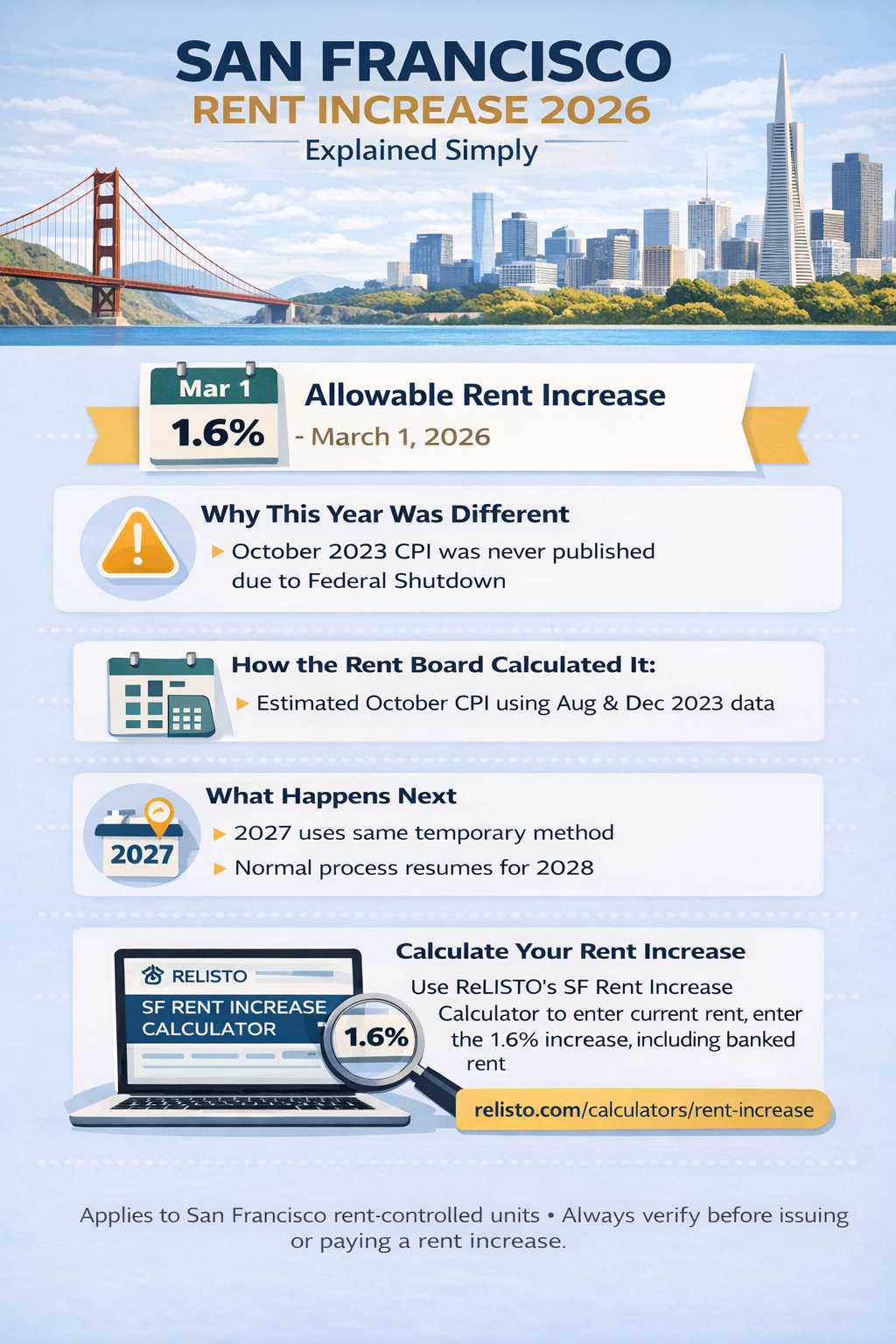
Each year, San Francisco sets a citywide limit on how much rent can be increased for rent-controlled apartments. For rent increases effective March 1, 2026 through February 28, 2027, the San Francisco allowable rent increase is 1.6%.

This percentage applies to San Francisco rent control units and is published annually by the San Francisco Rent Board. While the percentage itself is straightforward, how it was calculated this year — and how it should be applied — is not.

Behind the 1.6% figure is an unusual situation involving missing federal inflation data, a temporary adjustment by the Rent Board, and a calculation process that many landlords and tenants are understandably confused about. Below is a clear explanation of what happened, what the current rent increase rules are, and how to calculate a lawful rent increase correctly.

How San Francisco Rent Increases Are Normally Calculated
Under the San Francisco Rent Stabilization Ordinance, annual rent increases are tied to inflation using the Consumer Price Index (CPI) for the San Francisco region.
Normally:
The Rent Board compares October-to-October CPI data
The allowable rent increase equals 60% of inflation
The result is rounded to the nearest tenth
The increase is capped at 7%
The increase becomes effective March 1 each year

This methodology has been used consistently for decades and applies to most rent-controlled apartments in San Francisco.

Why the 2026 San Francisco Rent Increase Was Different
In 2025, a federal government shutdown prevented the U.S. Bureau of Labor Statistics from publishing the October 2025 CPI. The BLS later confirmed that this data will never be published retroactively.

Because San Francisco law specifically requires an October-to-October comparison, the Rent Board could not calculate the annual allowable rent increase using its normal method — not just for 2026, but for two consecutive years. This created a technical problem, not a policy change.

How the San Francisco Rent Board Calculated the 1.6% Increase
To address the missing CPI data, the Rent Board considered two approaches. The method ultimately used was to estimate the missing October 2025 CPI using a recognized statistical technique called a geometric mean.

In simple terms:
The Rent Board used published CPI data from August 2025 and December 2025
It calculated the midpoint between those two figures
That estimate was used in place of the missing October data

This approach allowed the Rent Board to:
Rely only on published federal CPI data
Preserve the long-standing October-to-October framework
Avoid skipping or double-counting inflation

Using this method, the San Francisco allowable rent increase for 2026 was set at 1.6%.

What Happens in 2027 (and Beyond)
Because the October 2025 CPI was never published, a similar temporary methodology will be required again for the 2027 allowable rent increase.

Once the CPI timeline fully moves past the missing data, the Rent Board can return to its standard calculation method. In other words:
2026 and 2027 are transition years
Future years will return to the normal process

What the 1.6% Rent Increase Means for Landlords and Tenants
Here’s what matters in practice:
1.6% is the maximum allowable rent increase for covered units
The increase applies to rent increases effective on or after March 1, 2026
Banked rent increases may still be applied where allowed
Rent control coverage and tenant protections have not changed
Improperly calculated increases may be partially or fully unlawful

Because banked rent and rounding rules apply, two landlords using the same percentage may still end up with different lawful rents.

Calculate Your San Francisco Rent Increase
San Francisco publishes the annual allowable rent increase percentage, but it does not provide a calculator that applies the increase to a specific unit or accounts for banked rent. That calculation is left to landlords and tenants to perform correctly.

ReLISTO’s San Francisco Rent Increase Calculator fills that gap. It allows landlords and tenants to calculate rent increases down to the penny, including the correct application of banked rent under San Francisco rent control.


Use the calculator here:
https://www.relisto.com/calculators/calculator/rent-increase

The tool is designed to eliminate guesswork, reduce disputes, and help both parties clearly understand what is — and is not — allowed per City guidelines. Best of all its free and you don’t need to enter any personal data!
If you’re planning a rent increase or reviewing one you’ve received, using a precise, rules-based calculator is one of the easiest ways to stay compliant and informed.


ALERT: Update to California Security Deposit Law — AB 414 Now in Effect

Posted: January 2026
Prepared by ReLISTO
A new California law — Assembly Bill 414 (AB 414) — is now in effect and will significantly change how landlords and property managers handle security deposits.

This law was passed in October 2025 and became active almost immediately, applying to new tenancies starting in 2026. While the intention may be to protect tenants, the speed of implementation presents real challenges for small landlords and housing providers.

What Changed?
The biggest change is this: If your tenant pays their security deposit through wire, ACH, or Zelle, you are now required to return it in the same manner — unless the tenant provides written authorization for you to return it another way (like by check). This is now part of California Civil Code §1950.5(h).

What Landlords Must Do
If you accept deposits electronically and want to return the deposit by check, you must obtain a written agreement from the tenant stating they agree to that method.

A landlord failing to follow this could result in:

  • Loss of the right to claim any portion of the deposit
  • Statutory damages of up to twice the deposit amount

Sample Agreement Language (For Tenants to Sign)

You can use the following clause or form to get written consent to return the deposit by check:

Security Deposit Return – Alternative Payment Method Agreement

This Addendum is incorporated into and made part of the Residential Lease Agreement
between Landlord and Tenant.

1. Acknowledgment of Electronic Payment
Tenant acknowledges that the security deposit was paid electronically, including but not
limited to payment by ACH, wire transfer, Zelle, or an online payment platform.

2. Notice of Statutory Right
Tenant is hereby notified that, under California Civil Code §1950.5, as amended by Assembly
Bill 414, when a security deposit is paid electronically, the Tenant has the right to receive
any refund of the security deposit electronically in the same manner or by an electronic method.

3. Voluntary Agreement to Alternative Method
Tenant voluntarily elects and agrees to receive any refund of the security deposit by check,
rather than electronically. Tenant understands that this election is optional and is not
required as a condition of tenancy.

4. Delivery of Refund
The refund check shall be made payable to the Tenant and mailed to the forwarding address
provided by Tenant within 21 days of move-out. If Tenant does not provide a forwarding address,
the refund check shall be mailed to Tenant’s last known address in compliance with applicable law.

5. No Waiver of Other Rights
This Addendum applies solely to the method of refund delivery and does not waive or alter any
other Tenant rights under California law, including but not limited to the statutory timeframe
for return of the security deposit and the requirement for an itemized statement of deductions.


Tenant Acknowledgment and Agreement

By signing below, Tenant acknowledges receipt of this notice, understands their right to receive
an electronic refund, and voluntarily agrees to the alternative refund method described above.

Tenant Name(s): _______________________________

Tenant Signature(s): __________________ Date: ____________

Landlord/Agent Signature: _____________ Date: ____________

Disclaimer: This sample agreement is provided for informational purposes only and does not constitute legal advice. Use of this form does not guarantee compliance with California Civil Code §1950.5 or other applicable laws. Landlords and property managers are strongly encouraged to consult with qualified legal counsel to ensure that any security deposit procedures, forms, or agreements are compliant with current state and local laws. ReLISTO and its affiliates are not responsible for any liability or damages arising from the use or misuse of this form.

Summary of California Security Deposit Laws (As of 2026)
Since there have been multiple changes lately, I have listed below a  summary of the most current rules as we understand them that California landlords must follow:

 Security Deposit Limits
– 1 month’s rent max for most rentals
– 2 months’ rent max only allowed for: Individual landlords or LLCs of natural persons or Owning no more than two properties totaling four units
– Service members: Never more than 1 month’s rent

Deadline to Return: Must return any unused portion of the deposit within 21 calendar days after the tenant vacates.

Return Method
– If paid electronically: Must be returned electronically
– Can only return via check if: The tenant signs a written agreement allowing it
– For multiple tenants: Default: Check made payable to all adult tenants. Can be changed with a written agreement (as will be required if sending electronically)

Required Photos
– Before tenancy begins
– After move-out, both: Before deductions/repairs and After work is completed
– Photos must be shared with the tenant via email, mail, or online link

Itemized Statement Requirements
Must include:
– Reasonable breakdown of deductions
– Receipts/invoices
– Labor costs with hourly rates
– Photos of damage or cleaning issues
– Can be delivered by mail or email (email only with tenant’s written/signed consent)

What Can Be Deducted
Allowed:

– Unpaid rent
– Damage beyond normal wear
– Cleaning to restore to move-in condition
Not allowed:
– Normal wear and tear
– Pre-existing conditions

Optional Pre-Move-Out Inspection
Tenants have the right to request a walkthrough before moving out. Landlords must:
– Give 48-hour notice
– Provide an itemized list of deductions
– Allow time to correct issues

Penalties for Non-Compliance
If a landlord wrongfully withholds a deposit or violates return procedures:
– May owe up to 2x the deposit in damages
_ The burden of proof falls on the landlord

Why This Matters
While the intent behind AB 414 is to improve transparency and strengthen tenant protections, the speed of its implementation has left many small landlords and property managers with little time to adjust internal systems and documentation. If you are a legislator, I strongly urge you to consider allowing more time between the passage and the enforcement of new housing laws — a one-year implementation window would be a reasonable and fair standard.

At ReLISTO, we remain committed to helping our landlord clients stay compliant, stay informed, and navigate the ever-changing landscape of California rental laws. We advocate for landlords while supporting independent owners in securing qualified tenants, and we also provide full-service property management.

We proudly serve San Francisco, the Peninsula, East Bay, North Bay, and surrounding areas. Contact us if you need expert help with leasing or managing your rental property — whether it’s a home, condo, or apartment.


The RealPage Lawsuit

A Question of Fairness in the Age of AI-Driven Pricing

In August 2024, the Department of Justice filed a lawsuit against RealPage and then subsequently multiple large property management companies,  alleging that its algorithmic pricing system has harmed millions of American renters by facilitating anti-competitive practices. The suit claims that RealPage’s software allows landlords to coordinate rent prices, potentially leading to artificially inflated rates that are beyond what renters can reasonably afford.

This raises an important question: In an era where listings are online and AI tools are widely accessible, is it fair—or even ethical—to criminalize advanced market analysis?

Here at ReLISTO, we utilize analytical tools to evaluate the strength of a property’s pricing before we even schedule the first showing. These tools give us immediate and accurate insights into market interest, allowing us to assess the strength of our bargaining position if someone wishes to negotiate. It’s a modern, data-driven approach that replaces guesswork with informed decision-making.

Yet, we wonder: Could tools and strategies like ours also be impacted by this lawsuit? If so, would that hinder innovation and the ability to price properties efficiently and competitively?

For context, RealPage’s platform aggregates rental market data and uses it to recommend pricing strategies for landlords. Critics argue that this goes beyond simple market analysis, crossing into price-fixing territory when landlords collectively rely on the same data and recommendations. However, tools like Zillow also use AI to analyze market trends and offer property value estimates, both for buying and renting. These tools empower individual users—whether homeowners or landlords—to make informed decisions about pricing.

At ReLISTO, we believe everyone should have the opportunity and ability to find rental housing that fits their budget. That’s why we think it’s important to go back to the root of the problem: the lack of housing. Many communities resist the construction of new homes and apartments, particularly those that cater to a diverse range of needs and budgets. This resistance perpetuates the housing shortage, driving up costs and reducing options for renters.

If we encouraged the building of more homes and apartments of all sizes, we could alleviate this issue. An increased housing supply would naturally lead to more competitive pricing, reducing the need for landlords to rely so heavily on tools to maintain their market positions.

The RealPage case may set an important precedent for how AI-driven market tools are regulated. But while this debate unfolds, let’s not lose sight of the bigger picture. Tackling the housing crisis at its core—by increasing supply—could eliminate many of these concerns altogether.